By Carolyn Bernhardt
January 15, 2026
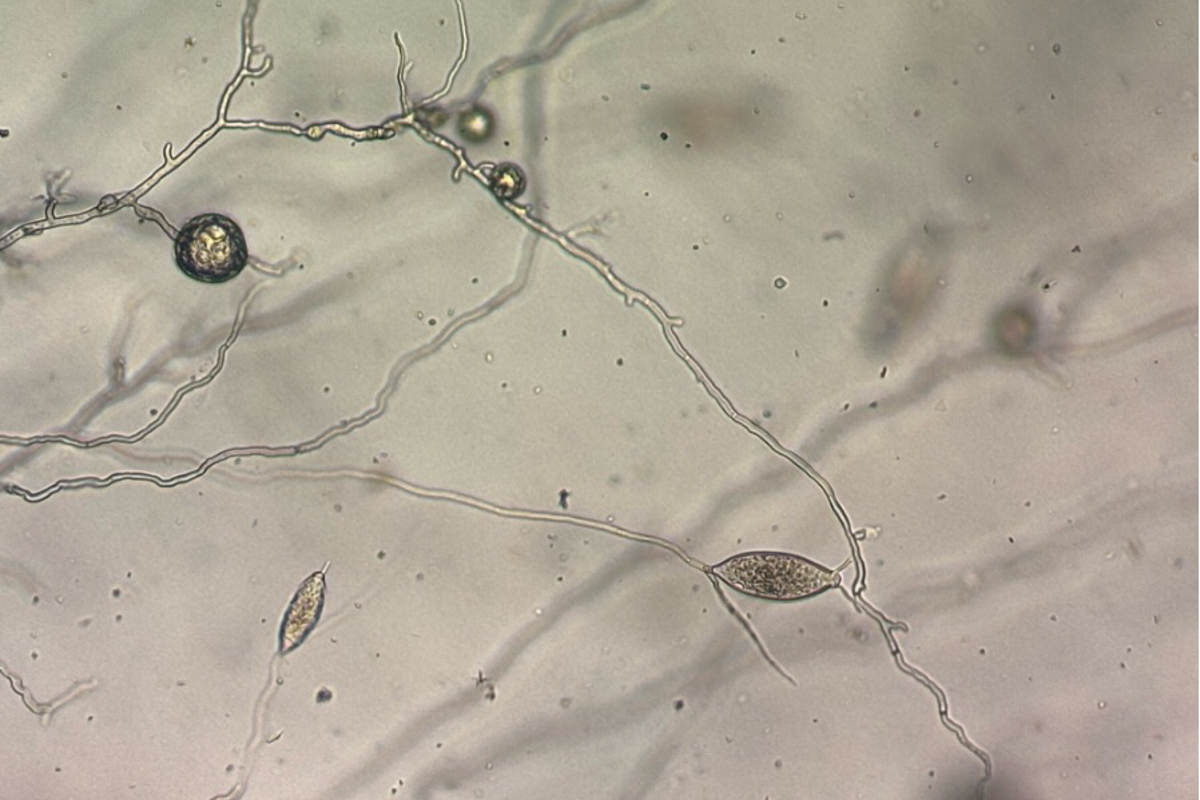
For the first time in the state’s history, researchers have identified the sudden oak death pathogen, Phytophthora ramorum, in a Minnesota nursery. “This is an incredibly serious pathogen with the potential to do a lot of damage to our oak and larch trees here in Minnesota,” says Nickolas Rajtar, PhD, a postdoctoral associate in the Blanchette Lab in the Department of Plant Pathology, who made the discovery in July. For decades, this tree disease has ravaged forest stands on the West Coast. Now, the pathogen is moving east, and with no available cure, early detection and containment are paramount to slow its spread.
Rajtar’s research focuses on Phytophthora, a fungal-like genus that has an incredibly large and diverse host range. Rajtar and collaborators made this discovery in July while working on a MITPPC-funded, multi-year project to detect invasive forest pathogens with high potential to harm Minnesota’s trees and cause major economic loss. “The goal of the biosurveillance project is to try and detect these types of pathogens before they can establish,” he says, “and I am happy to say biosurveillance works!”
Finding confirmed
Rajtar and undergraduate research assistant Greta Lane made this discovery while sampling plants and soil at a Hennepin County nursery. “We process hundreds of samples each sampling season,” he says, “so there wasn’t anything initially that stood out to me when I was at the nursery, except that they had some diseased rhododendrons.” While sampling at nurseries, Rajtar says he looks first for diseased plants, particularly rhododendrons, azaleas, hardwood trees, and conifers. The pair took the plants and soil back to the lab and processed them, as they do with all their samples.
When the results came back as Phytophthora ramorum, Rajtar says he was shocked and skeptical. “We needed to sequence additional genes of the pathogen to make sure the species identity was correct.” After sequencing more genes, all signs pointed to P. ramorum.
The team then sent a DNA sample and pure culture of P. ramorum to the Minnesota Department of Agriculture and the North Central Plant Diagnostic Network at Michigan State University, both of which also confirmed the species as P. ramorum. “Because this is such a serious pathogen, we wanted to be 1,000% sure it was P. ramorum before we alerted government agencies,” says Rajtar.
Ongoing surveys for pathogens

Rajtar relies on nurseries and Christmas tree farms in the state for a large part of his research. He has partnered with 15 nurseries and five Christmas tree farms, and says the team is always looking for more that will allow them to come take samples. “This is a completely free and confidential service for them,” he says. “I don’t publish or disclose any names in my research, and I am extremely appreciative of their collaborations.”
He takes pieces of the plant and soil from the pot to determine what might be causing the plant to look diseased. “The process from sampling to making isolations, to getting pure cultures of the pathogen, to extracting the DNA takes a little bit of time—around a month to two months to get results of which species are present at each location,” he says.
Two different oak tree diseases
Rajtar explains that sudden oak death and oak wilt are entirely different diseases from one another. “While it is true that both pathogens kill oak trees, oak wilt is caused by a fungus, and sudden oak death is caused by an oomycete—a water mold closely related to algae,” he says. “Oak wilt is well established and reported in the Twin-Cities, North Metro, and down in Southeast Minnesota.” He says he has seen confusion online, where some think that oak wilt and sudden oak death are synonymous, but they are in fact not.
He says, “While it is unclear if the sudden oak death pathogen can survive Minnesota winters, it is one pathogen we don’t want to gain a foothold here in the state.” The infection detected at the nursery appears to be an isolated incident. Rajtar’s biosurveillance work continues with support from MITPPC through the Environment and Natural Resources Trust Fund.
The Minnesota Invasive Terrestrial Plants and Pests Center research is supported by the Environment and Natural Resources Trust Fund, as recommended by the Legislative-Citizen Commission on Minnesota Resources.
Stay connected by signing up for the MITPPC newsletter.
More information
- Biosurveillance of invasive pathogens of woody plants in Minnesota, research project
- Sudden oak death pathogen detected for the first time in Minnesota nursery, UMN News
- Sudden oak death information, Minnesota Department of Agriculture
- Identifying Phytophthora and emerging plant pathogens entering MN through new pathways, research project